

A training sample, a weight file, an inference call—who should be paid? Traditional platforms answer with their own ledger and a paper agreement; contributors can neither easily verify nor enforce. Missing rights are first an engineering and institutional gap, not a slogan gap. This piece outlines mechanisms that make rights executable, and how Bitroot-related designs sit on settlement and trusted computing.
Three murky ledgers
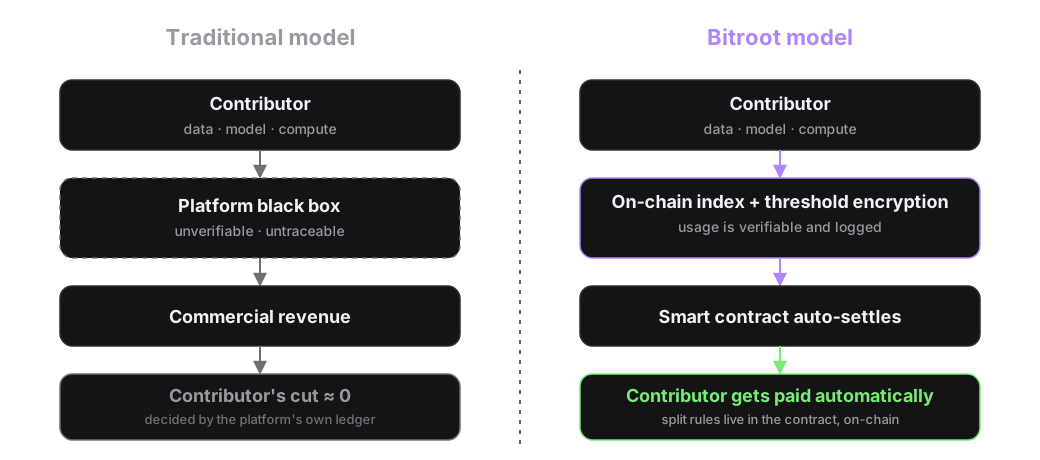
Data: Once handed to a platform, contributors often cannot prove which models used their samples, let alone claim a share when models earn revenue. Data becomes disposable feedstock instead of a traceable asset.
Models: Parameters and structure are digital assets without common rights, licensing, and call metering. When weights live in one place, outsiders cannot independently check call counts or revenue; designers accept the platform’s settlement sheet.
Revenue: Even willing platforms still rely on manual audit and offline contracts—slow and dispute-prone. Data, model, and compute parties lack a shared payout state machine that runs as written.
Going “on-chain” does not erase these gaps by itself; the chain only supplies a programmable, auditable execution environment. For the trust-gap map, see Web3 and AI Convergence.
From platform books to a verifiable pipeline
The diagram contrasts unilateral platform accounting with an index + cryptography + contract value-flow intuition (illustrative—not a financial promise):
On-chain metadata, not the whole corpus
A sane approach registers file hashes, versions, sizes, and diff digests on-chain; payloads stay in decentralized or object storage, with shard delivery and Merkle checks for download integrity. Anyone can verify that retrieved shards match registration—the chain need not host raw corpora. That is not the same as “mint the dataset as an image.”
Access control: threshold keys + optional TEE audit
Commercial data and models need access control. Threshold encryption / MPC splits keys so decryption or signing requires a quorum, shrinking single-node theft. Access and authorization changes should leave on-chain records; sensitive slices can run inside TEEs for hardware-bounded use audit—accepting side-channel and supply-chain risk. Division of labor: Trusted Computing Framework.
Model weights: usable without being takeable
One hard problem in model assets is letting nodes serve inference without giving any single counterparty the full weights. An engineering path is (t, n) threshold sharding: any t shares can help aggregate an inference result; fewer than t yield no usable weights. Nodes compute on local shares, aggregate via MPC, and may attach ZK constraints to check output integrity.
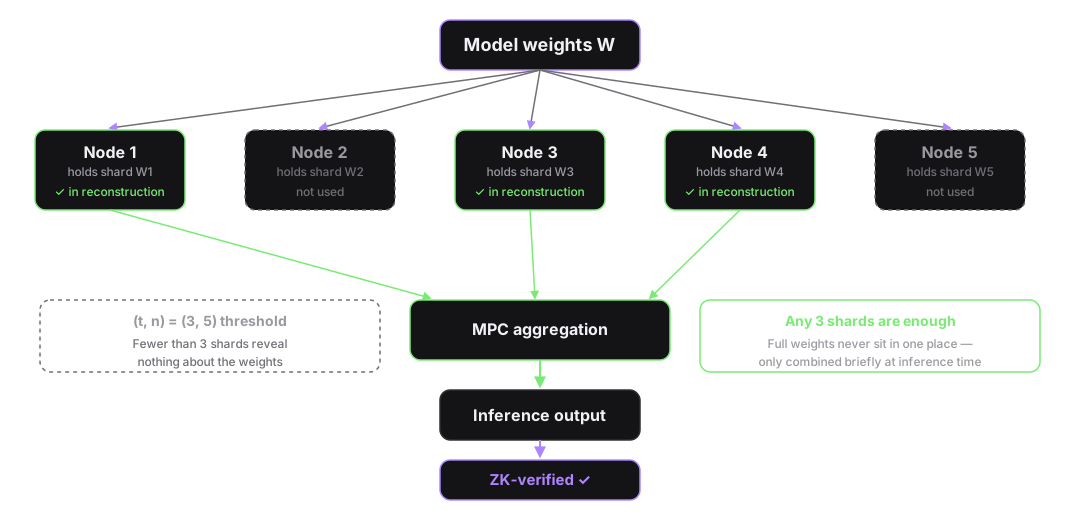
Use rights and full ownership can be split technically; legal copyright and licensing still need contracts and jurisdictions—on-chain rules do not replace every copyright statute.
Smart-contract splits: shares as a state machine
When calls generate revenue, contracts trigger payouts from pre-registered shares: data contributors, model designers, and compute providers each have on-chain ratios; every settlement is auditable. That answers whether rules execute—not whether ratios are fair (still governance and negotiation).
Social login / threshold session keys lower the private-key UX bar but expose custody and recovery to the MPC participant set; write that threat model explicitly.
How this meets settlement and compute
Rights and payout machines need predictable confirmation and enough throughput—especially for high-frequency inference billing and multi-contract splits. When an optimistic parallel EVM is the settlement substrate, read performance figures as testnet/engineering targets and watch whether conflict hotspots collapse parallelism—see Parallel EVM Architecture Overview and Performance Metrics Glossary. Job acceptance and payment interfaces: Distributed GPU and Edge Compute. Capability boundaries: AI-Native Blockchain.
This article does not discuss or imply any yield or investment return.
Three common design pits
Ownership as display-only without revoke/split transitions; unchallengeable metering that recentralizes billing; ignoring version/license inheritance for fine-tunes and distillation. A stabler MVP: hash registration + simple per-call splits + revocable licenses, with disputes working before complex threshold schemes. Keep mechanism talk separate from yield imagination. Whether settlement survives micropayment splits: Multi-Engine Parallel Execution Design.
Across jurisdictions, on-chain rules at best provide “auto-executing programs parties agreed to”; they do not erase off-platform copying or adjudicate whether training corpora infringe. Docs should state what the system guarantees (hashes, license events, split execution) and what it does not (global copyright title, yield levels). Access protection: Trusted Computing Framework; trust gaps: Web3–AI Convergence.
If splits involve many tiny high-frequency payments, also evaluate account abstraction, batched settlement, or off-chain channels so gas and confirmation jitter do not eat the split itself. Those are application architecture choices on top of settlement capability—not reasons for an L1 to subsidize every split. This is not investment or yield advice.
Metering, revoke, and disputes: the back half of rights
Hash registration is only the start. Executable rights also need anti-double-count metering, stop-billing on license expiry or breach, multisig/governance for share changes, and the ability to freeze flows during copyright disputes without destroying audit trails. Without those state machines, on-chain indexes are expensive primary keys.
When wiring to compute networks, acceptance must not auto-equal “payable”—callers still need a valid license. High-frequency micro-splits on a parallel settlement layer amplify gas and conflict surface; off-chain aggregation with challengeable detail commitments may be required. Conflicts: Conflict Hotspots and Workloads. Stack place: The Decentralized AI Stack.
Tension between privacy and public audit
Rights want auditability; commercial data wants confidentiality. Threshold sharding and TEEs help, but cannot simultaneously give “anyone verifies every inference” and “weights never leave a trusted set” at near-zero cost. Products must choose a primary audience: regulator audit, contributor payout checks, or public verifiable inference—each with a different cost curve.
Avoid implying full privacy, full public verifiability, and near-zero cost at once. Honest layering: on-chain metering and splits; authorized off-chain details; minimal evidence on dispute. Trusted computing roles: Trusted Computing Framework.
Takeaway
Executable rights need checkable metadata, threshold keys and weights, auditable access, and automatic payout contracts—layered with trusted computing and settlement. They move “who contributed what, under which rule” from a platform black box into a verifiable state machine. They do not auto-settle copyright disputes, nor turn compute networks into yield products. When reading related materials, prioritize threat models and acceptance flows.